

Resource Management of the Nullarbor Region, W.A. A report prepared by the Australian Speleological Federation for the Western Australia Environmental Protection Authority. Edited by A.G. Davey. 1978

Davey, A. G., et al. 1992. World Heritage significance of karst and other landforms in the Nullarbor region - a report to the Commonwealth Department of the Arts, Sport, the Environment and Territories, Commonwealth of Australia, Canberra.

Williamson, D. 2009. Interim management guidelines for the Nullarbor caves and selected karst features. Report to Department of Environment & Conservation, Western Australia, and the Rangelands NRM Co-ordinating Group. Melbourne: Department of Environment & Conservation, Western Australia.
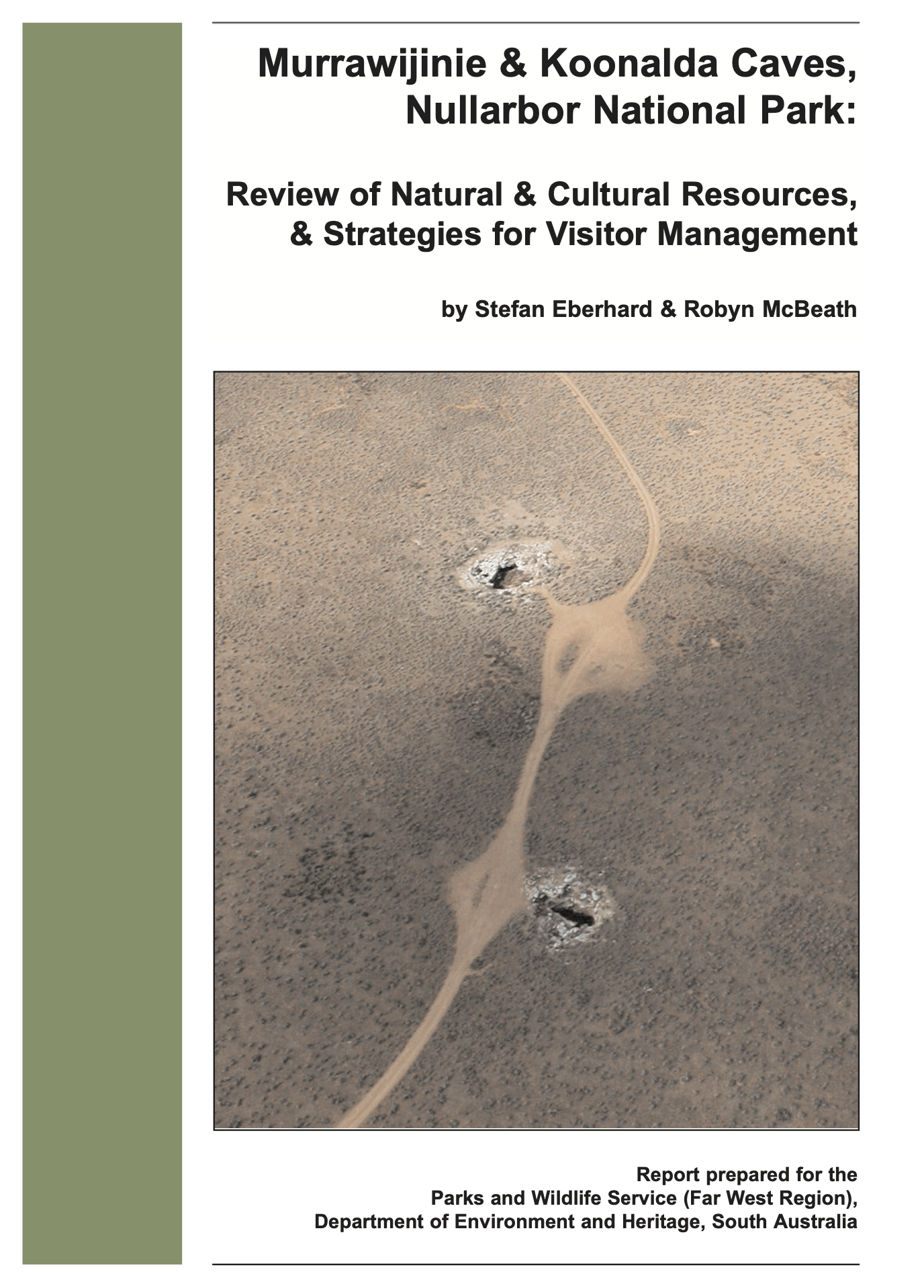
Key Recommendation made in 2003...
"In view of the outstanding importance of Koonalda Cave, it’s proper protection must be a paramount aim in all management planning and future actions. In consideration of this, there exist two key conservation and management issues that need to be urgently addressed:(1) Control of unauthorized entry into the cave;(2) Conservation of archaeological and cultural heritage values."
Eberhard, S.M. & McBeath, R.M. (2003) Murrawijinie & Koonalda Caves, Nullarbor National Park: Review of Natural & Cultural Resources, & Strategies for Visitor Management. Report prepared for Parks and Wildlife Service (Far West Region), Department of Environment and Heritage, South Australia
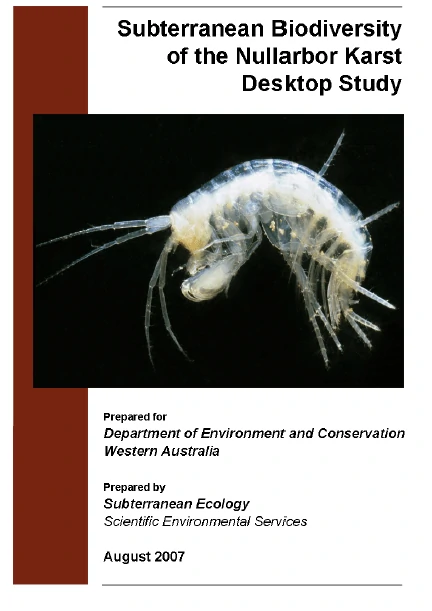
"The Nullarbor caves contain a diverse invertebrate fauna that includes several remarkable obligate subterranean species (troglobites and stygobites). However, knowledge of the Nullarbor cave fauna is very incomplete; many caves have not been systematically sampled for fauna, and those caves from which collections have been made have generally only been sampled on a few occasions. The caves and dolines are also important for vertebrates, and they are a critical habitat for some species of birds and bats which roost and breed inside them. Some elements of the cave fauna and fauna habitats are fragile and vulnerable to human disturbance."
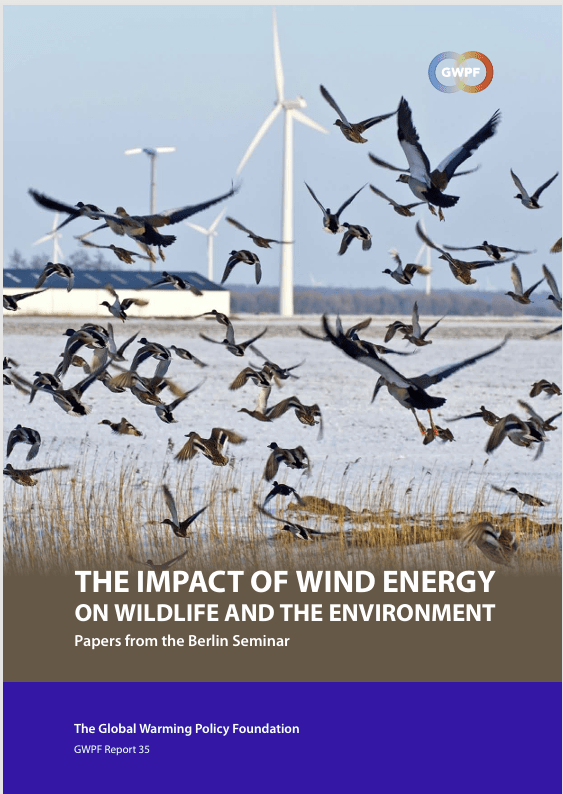
"We are not opponents of wind energy. Where wind energy makes sense it should be used. Wherever it is unreasonable and destructive, it should be avoided. The problem, of course, is that we often don’t fully understand the positive and negative impacts. I hope that this booklet will allow readers to have a better understanding of both German and international developments, so that the interested public can get a better picture of these particular problems of conservation."

“This paper examines the reasons green hydrogen will likely remain prohibitively expensive, why projects are stalling, and how the recently announced Orica subsidy exposes Australia’s strategy as untenable. Green hydrogen is often heralded as a cornerstone of Australia’s net zero ambitions, but the reality is that it is not viable today and won’t be in the foreseeable future.
The reliance on subsidies, even for the simplest use case of on-site chemical production, suggests that more complex applications are even less viable. The Orica project exposes a push to prop up a technology whose costs are driven by immutable physical constraints, raising serious questions about the feasibility of Australia’s green hydrogen strategy.
It is essential that Australia removes unrealistic assumptions about green hydrogen from official plans, including the Integrated System Plan, to prevent us committing today to investments and strategies which have no real prospect of success.
Hydrogen has been ‘the future’ at least four times. The simplest of elements, it appears to have an intoxicating allure to the modern mind, capable of generating sequential waves of official enthusiasm about its potential, without any of the expectations coming to fruition.”